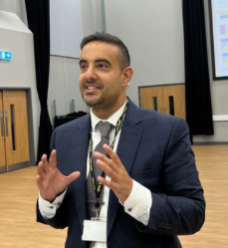

Duncan Baldwin is the former Deputy Director of Policy at ASCL. He is a former teacher and head teacher. He is a school improvement partner and chair of EduDATA
What gets teachers down?
I was working at ASCL when Nicky Morgan, the Secretary of State for Education at the time, commissioned a major survey into teacher workload. The profession was under intense pressure, with increasing numbers of teachers leaving, often after just a few years.
The response was overwhelming, so much so that the Department for Education had to pause normal operations and redeploy civil servants just to process the data.
What followed was familiar: concern, discussion, and a scratching of heads in search for answers. Why was workload so high? Who was responsible? What could be done?
Predictably, the “accountability elephant in the room” remained largely unaddressed. Instead, the spotlight turned to Ofsted and, by extension, to school leaders as they tried to protect their schools from inspection. Surely they must be the ones causing the problem? Toolkits were produced. Guidance was issued. And, with irony lost on no one, Ofsted began inspecting how schools were reducing workload.
The real issue was never teaching itself.
The survey findings were revealing. Teachers consistently identified three key pressures: lesson preparation, marking, and data. What they didn’t complain about, interestingly, was teaching itself. Time in the classroom felt different. It was purposeful and efficient. I dare say, teachers even enjoyed it.
The difference comes down to the nature of the interactions teachers actually undertake in the rest of their role.
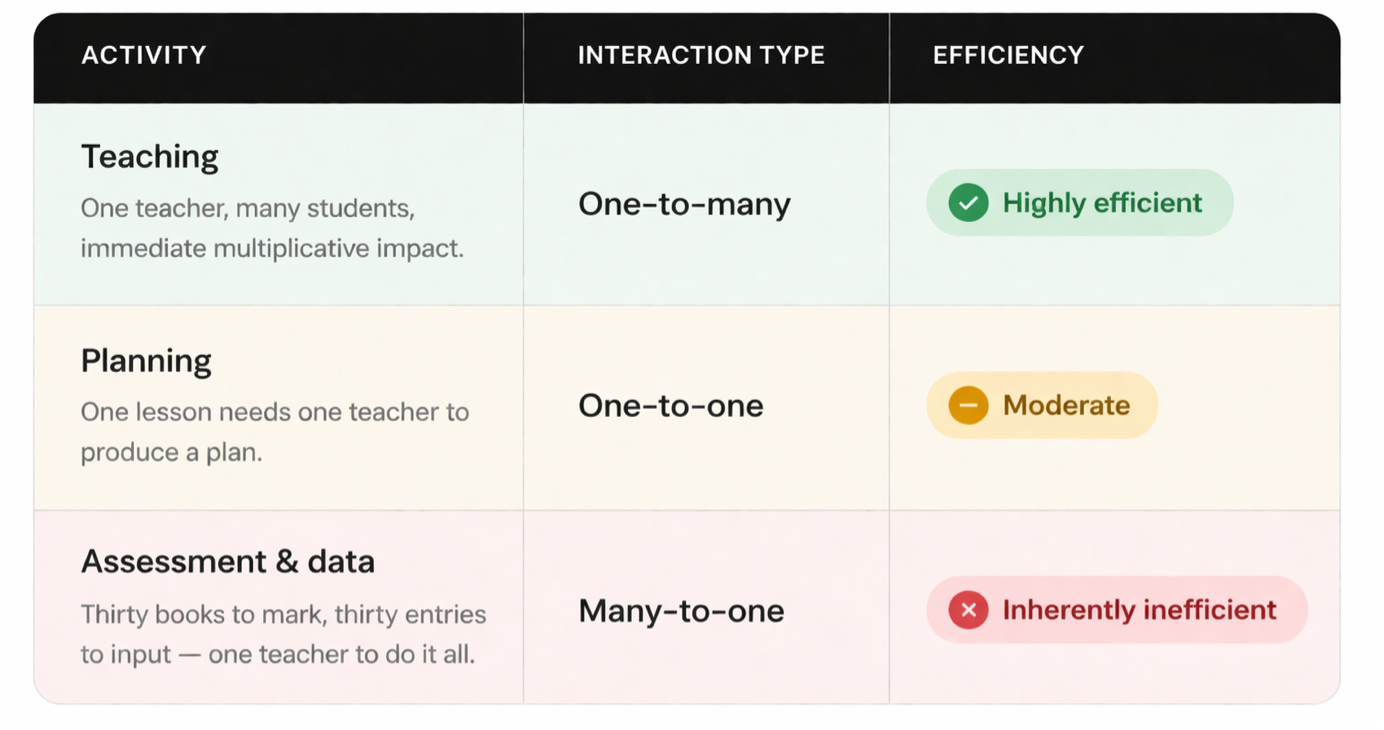
Teaching in a classroom is efficient. It’s a one-to-many interaction: one teacher, many students, immediate multiplicative impact.
Planning is less efficient. Every lesson needs a plan but this is typically a one-to-one process, one lesson needs one teacher to produce a plan. I should add that team planning really helps, but you still need to review what you will be teaching as an individual.
But assessment and data are where the real inefficiencies start. These are many-to-one interactions: thirty books to mark, thirty entries to input into the school’s system but just one teacher to do it all.
This is the structural flaw at the heart of teacher workload. It’s not just demanding, it’s inherently inefficient.
A turning point: AI and assessment
I was introduced to Running Paper when I had stepped back from full-time school leadership. I was observing from my semi-retired armchair as artificial intelligence began to wash over education like a tsunami. I was somewhat grateful to view from a distance.
Schools are always expected to adapt quickly to technological change. We’ve seen it with calculators, computers, the internet, learning systems and mobile devices. Now, the expectation is that schools will rapidly understand and implement AI. But where do they start?
When I saw what Running Paper could do, I knew immediately that it could address the problem of excessive workload at its core. By digitising handwritten responses and using large language models to evaluate students’ responses against mark schemes, it transforms assessment into something far more efficient. Teachers retain full professional agency, but the time-consuming parts of the process are dramatically reduced. The additional collateral produced, such as question level analysis, whole class summaries and even emails to parents about their child’s assessment would be unthinkable without AI.
What previously took hours, if it was done at all, can now be done in minutes. As one teacher told me: “It’s done all this before I can get back to the staffroom for a brew”.
From burden to opportunity
If we can reduce the time spent on the most inefficient aspects of the job, we don’t just ease workload, we change the experience of teaching itself and, I believe, we can make a real difference to teacher retention. The worst part of the job suddenly becomes a joy.
Assessment, long seen as a burden, becomes deliverable. Teachers know that assessment and feedback are important but it ends up as the poor relation in the canon of teachers’ activities because of the time it takes.
Proceed with caution, but proceed
Of course, we are still in the early stages. There are valid questions around reliability, subject variability, professional trust, and data security. These must be addressed carefully.
But we should not lose sight of the opportunity. This is a practical, tangible starting point, one that directly addresses a long-standing issue in education. And let us not forget that assessment carried out by teachers has plenty of issues too. Who amongst us has not listened to a room full of English teachers with a room full of different opinions about the same piece of work?
Where schools should begin
If schools are looking for a meaningful entry point into AI, assessment is a great place to start. Not because it is easy but because it is where the need is greatest, and the potential impact is immediate.
For years, we have tried to reduce workload through guidance, good will and surface scratching. What we now have is the possibility of doing so through amazing technology. It’s even worth coming out of retirement for.