
GCSE Physics Higher · 63-mark paper · benchmarked against moderated examiner marking on 100 exam scripts.
Key results:
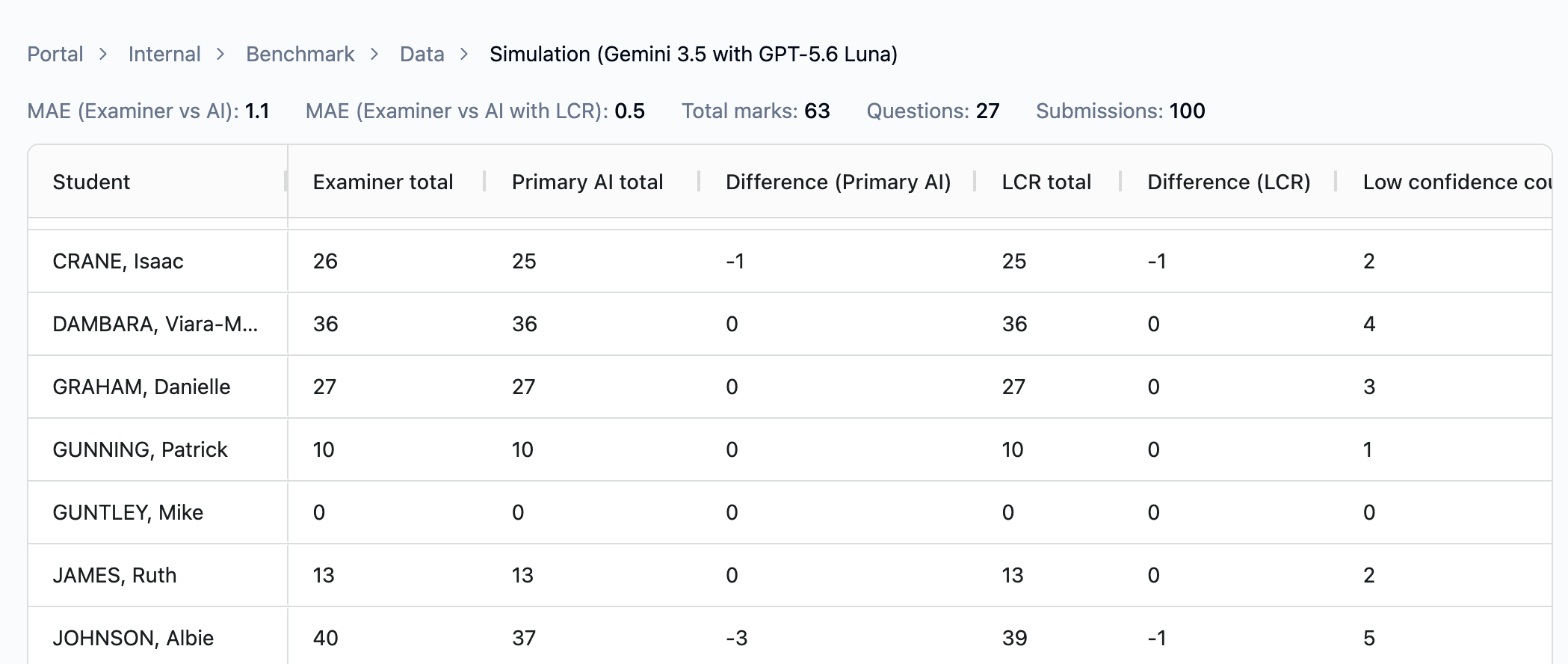
- Mean absolute error of 0.5 marks after low-confidence review (1.1 marks before review).
- 19.1% of questions flagged as low confidence for teacher review.
- Every script within two marks of the examiner’s total after review.
The paper we tested
This benchmark covers a whole GCSE Physics Higher paper worth 63 marks, rather than a single question. We used 100 exam scripts, each marked to an agreed standard by former exam board examiners and experienced subject leads. Where those markers disagreed, the question was moderated and an agreed position established. Those moderated marks are the definitive benchmark.
The configuration
| Exam paper | GCSE Physics Higher |
| Paper total marks | 63 marks |
| Exam scripts | 100 |
| Primary model | rp-gemini-rag |
| Validating model | rp-gpt-rag |
Both models in this configuration are Running Paper retrieval-augmented models, built on different underlying frontier models from different providers. Every question is marked independently by both. Where they disagree beyond the tolerance set for that question, the question is flagged as low confidence for the teacher to review. You can read more about the process in how we measure accuracy.
Results
| Measure | Result |
|---|---|
| Questions flagged as low confidence | 19.1% |
| Mean absolute error (MAE), primary model, before review | 1.1 marks |
| Mean absolute error (MAE), after low-confidence review | 0.5 marks |
| Marks within one-mark tolerance, after review | 95% |
| Scripts within two-mark tolerance, after review | 100% |
Reading these figures
The flag rate of 19.1% means roughly one question in five was flagged as low confidence.
The reduction in mean absolute error from 1.1 to 0.5 marks is the low-confidence mechanism working as designed. The MAE of 1.1 marks is the primary model marking alone. The MAE of 0.5 marks is after the low-confidence questions have been corrected.
It is worth stating plainly: the accuracy that matters is not the model’s accuracy. It is the accuracy of the model, the validator and the teacher working together. The residual 0.5 marks is not zero and we do not present it as such. It represents errors that survived both the validation comparison and teacher review.
The post-review MAE (0.5), the 95%, and the 100% figures above are drawn from a simulation that assumes every flagged question is corrected to the definitive mark. They show the accuracy the system is designed to achieve once low-confidence questions are addressed.
If you would like to know how the system performs on your subject, get in touch via the contact form or book a demo below.